TECH-PACK DEVELOPMENT (production flats)
Tech-Pack Development (Production Flats):
The creation of the "Garment Blueprint." Using Adobe Illustrator, students produce high-precision technical drawings (Flats) and compile the data—measurements, materials, and construction notes—required for error-free manufacturing.
Tech-Pack Development is the essential module that prepares students for global manufacturing. It focuses on the creation of the "Industry Blueprint," ensuring that every design detail is documented with absolute mathematical and visual clarity.
Instructor Profile
Prerequisites
Description
Course Topics & Modules
1. High-Precision Production Flats (CAD)
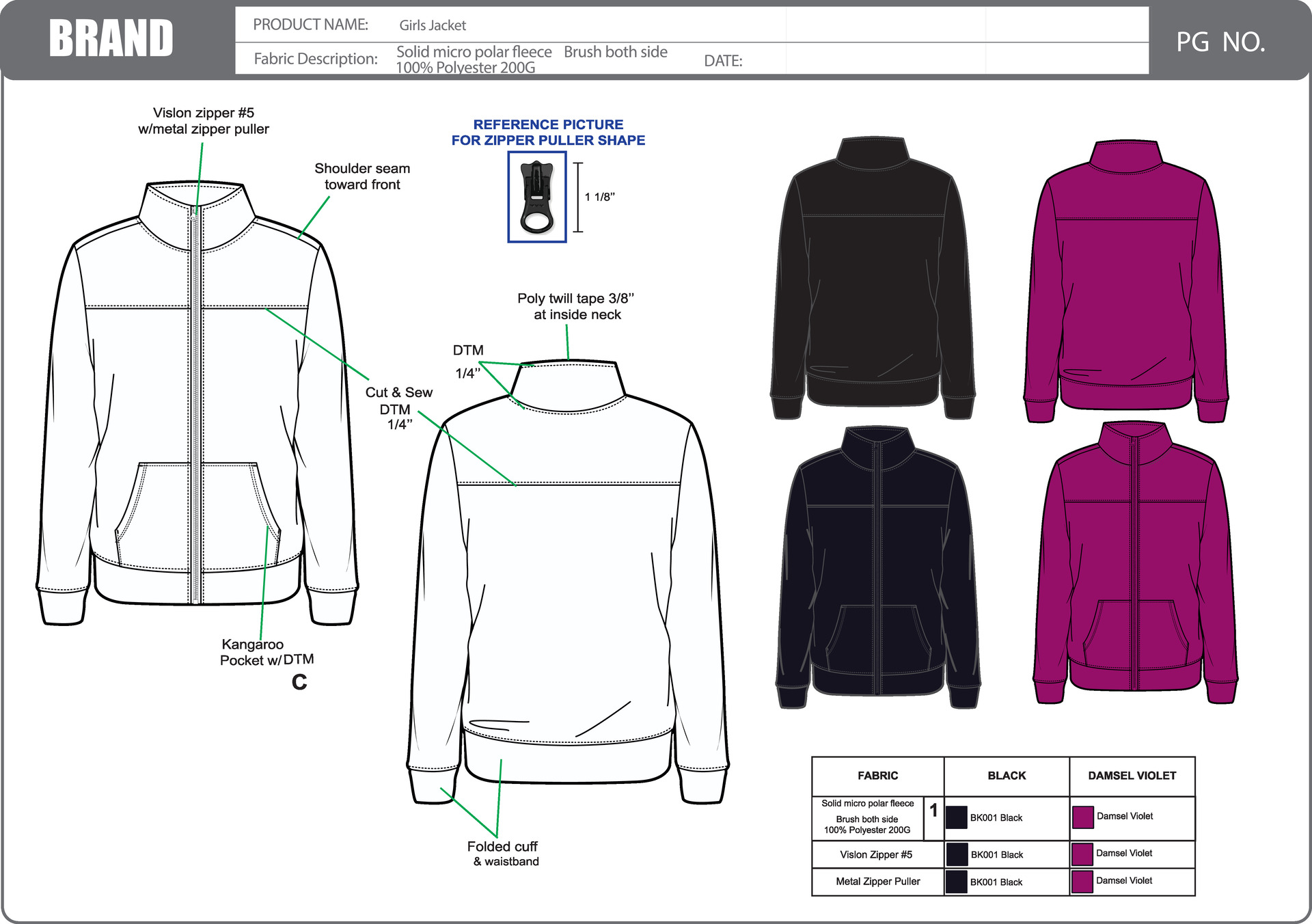
The Industry Standard Flat: Utilizing Adobe Illustrator to create 2D "technical drawings" of garments. Unlike artistic illustrations, these flats are drawn to scale, showing every seam, topstitch, and button in Front, Back, and Profile views.
Layering & Call-Outs: Mastering the "exploded view" technique—creating detailed zoom-ins of complex construction areas like pocket interiors, fly-zipper assemblies, and hidden internal supports.
Standardized Line Weights: Learning the industry language of lines: solid lines for seams, dashed lines for topstitching, and dotted lines for internal reinforcements.
2. The Bill of Materials (BOM) & Component Mapping
Raw Material Inventory: Documenting every physical element of the garment. This includes primary fabric (self), lining, thread types (tex), interfacings, and brand labels.
Hardware Specifications: Creating a precise list of "trims" (zippers, buttons, rivets, and buckles), including their exact dimensions, finishes (e.g., matte black vs. polished nickel), and supplier sources.
Colorway Planning: Managing "Lab Dips" and Pantone color standards to ensure color consistency across different materials in a single garment.
3. Measurement Specs & Point of Measurement (POM)
The Spec Table: Creating a master list of dimensions (e.g., chest width, sleeve length, high-point-shoulder to hem) for a sample size.
Point of Measurement (POM) Diagrams: Drawing "measurement guides" that show a factory exactly where to place the tape measure to ensure quality control (QC) consistency.
Grading Integration: Applying the mathematical rules learned in Stage 2 to the Tech-Pack, showing how measurements "step" up and down for every size in the production run.
4. Construction Instructions & Quality Control (QC)
Stitch & Seam Codes: Utilizing international standards (e.g., ISO 4915) to specify exact seam types (e.g., Flat-lock, French seam) and stitch densities (stitches per inch).
Packaging & Labeling Specs: Designing the final presentation of the product, including hang-tag placement, care-label instructions, and folding requirements for shipping.
Digital Integration: Learning to export Tech-Pack data directly from 3D software like CLO 3D to synchronize virtual prototypes with factory-ready spreadsheets.
High-Precision Hand-Flats: Utilizing fine-liner technical pens (0.05mm to 0.8mm) and French Curves to draw perfectly symmetrical 2D "Flats." These are drawn on graph paper to ensure mathematical accuracy.
The Manual Spec Sheet: Hand-writing the "Garment Instruction Manual." Students document measurements, stitch densities (Stitches Per Inch), and seam types using professional standardized codes.
Tactile Bill of Materials (BOM): Creating a physical "Swatch Board" that includes actual physical samples of fabric, thread, buttons, and zippers, taped and labeled for the factory.
2026 Learning Outcome
Upon completion, students will be able to produce a professional, 15-20 page Tech-Pack for any garment. This document serves as the final "Design Spec" for their Capstone Project, proving their ability to communicate complex design data to any manufacturer worldwide with zero ambiguity.
Course Rules
Ready to Enroll?
Preserve your seat by filling in the application form, upload a sample of your artwork, or provide your Artstation account for revision. Kindly, Do Not pay unless you have a confirmation message from us that you are accepted in this course.