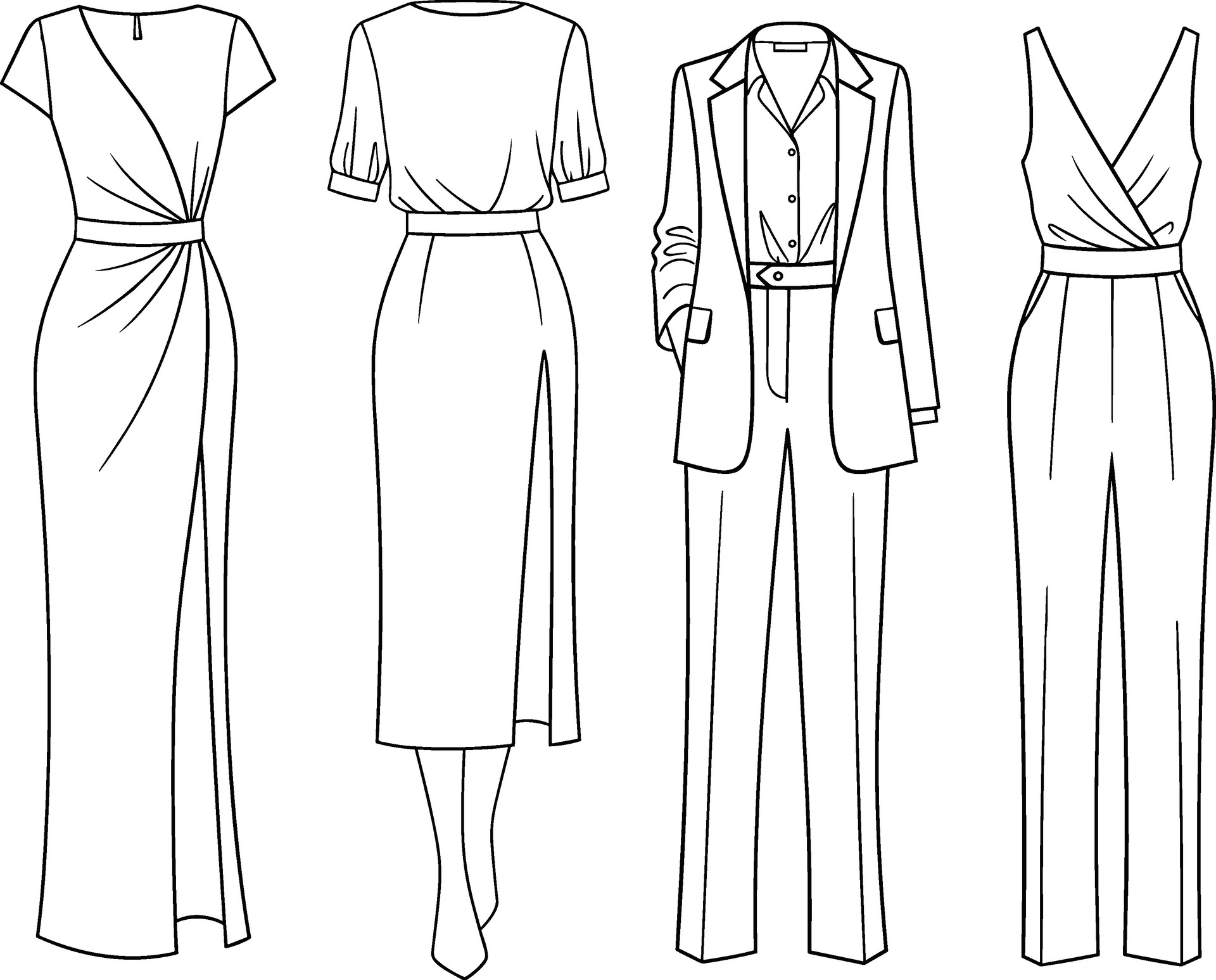
ANATOMY FOR DESIGNERS & HUMAN FRAME
Anatomy for Designers & The Human Frame is the foundational pillar of the first stage of study. It shifts the focus from "drawing pretty pictures" to "understanding anatomical architecture," ensuring that every design is rooted in the reality of human movement and 3D volume.
Course Introduction
This course serves as the designer's introduction to the body as a structural canvas. Before a student can manipulate fabric, they must master the "armature" upon which fashion is built. By deconstructing the body into its skeletal gestures and geometric volumes, students learn to perceive the human form not as a static image, but as a dynamic, three-dimensional machine. This anatomical mastery is the prerequisite for achieving professional proportions, balanced silhouettes, and ergonomic fit in all future design stages.
Instructor Profile
Prerequisites
Visual Language of Fashion (Elements & Principles)
Description
Course Topics & Modules
1. The Skeletal Armature (Skeletal Gestures)
The 10-Head Proportion: Mastering the industry-standard elongated fashion scale to establish professional heights and widths.
The Plumb Line & Balance: Understanding the vertical axis of gravity and how to maintain balance in any pose.
Dynamic Posing: Using "gesture lines" to capture the curve of the spine (the S-curve) and the tilt of the shoulders versus the hips (Contrapposto).
Joint Pivot Points: Identifying the anatomical "hinges" (shoulders, elbows, hips, knees) to ensure garment movement is realistic.
2. Body Mass & 3D Geometry (Geometric Volume)
Volumetric Blocking: Translating the body into simple 3D shapes: cylinders for limbs, spheres for joints, and "torso boxes" for the chest and pelvis.
Perspective & Foreshortening: Learning to draw the body from different angles (front, 3/4, side, and back) to visualize how a garment wraps around a physical form.
Anatomical Landmarks: Identifying key bone-surface points (the clavicle, seventh cervical vertebra, and iliac crest) used as "anchor points" for future measurements.
3. Anthropometry & Diverse Body Types
Standard vs. Realistic Sizing: Comparing idealized fashion proportions with real-world anthropometric data.
Body Shape Analysis: Studying different anatomical structures—such as ectomorph, mesomorph, and endomorph—to prepare for inclusive design.
Gendered Proportions: Analyzing the skeletal differences between male, female, and non-binary frames to inform specialized tailoring.
4. Surface Anatomy & Muscle Definition
Muscular Landmarks: Studying the major muscle groups that affect the "drape" of a garment, such as the trapezius (neck/shoulders) and the quadriceps (thighs).
Movement & Skin Tension: Understanding how the skin stretches and compresses over muscles during movement, which dictates where "ease" must be added to a pattern.
2026 Learning Outcome
Upon completion, students will be able to manually draft a professional anatomical croquis from any angle without a reference. This "Human Frame" becomes the template for the next stage, Advanced Garment Realization, where students begin to layer Silhouette Theory and Pattern Engineering over these mastered proportions. For professional anatomical references, students utilize digital archives such as the Primal Pictures Anatomy or Pinterest Fashion Anatomy Boards.
Course Rules
· Attendance Policy: Participation is mandatory; exceeding a 15% absence rate will result in an automatic failure of the course.
· Grading Criteria: Final grades are calculated based on a combination of consistent attendance, completion of practical assignments, and the quality of the final project.
· Punctuality & Professionalism: Arriving late or leaving early frequently is often penalized as a partial absence. Students are expected to treat the classroom like a professional studio, maintaining high standards of conduct and communication.
· Submission Deadlines: Late submissions for assignments or the final project are generally not accepted or are subject to significant grade deductions unless an official medical excuse is provided.
· Originality & Academic Integrity: All motion assets, animations, and project files must be the student's original work. The unauthorized use of AI-generated assets or "stealing" project templates without significant modification is strictly prohibited and can lead to immediate disqualification.
· Hardware & Software Requirements: Students must ensure their personal workstations meet the 2026 technical specifications for rendering (typically requiring high-end GPUs and 32GB+ RAM) to prevent project delays during the final rendering phase.
· In-Class Engagement: Active participation in peer critique sessions is often a mandatory component of the "Attendance" grade, requiring students to provide constructive feedback on others' work.
Ready to Enroll?
Preserve your seat by filling in the application form, upload a sample of your artwork, or provide your Artstation account for revision. Kindly, Do Not pay unless you have a confirmation message from us that you are accepted in this course.